
Building vs. Buying a First Aid Kit
If you spend enough time teaching wilderness medicine, you hear some questions repeated. One of the most common is: "Should I make my own first aid kit… or just buy one?”
It's a great question. And like a lot of unsatisfying answers in medicine, it depends. Let's unpack the dependencies. But first, the harsh reality.
The Smoke, the Mirrors, and the Tourniquet That Isn't
We started stocking kits years ago to support newly minted graduates who wanted to walk out of class with something that matched their training. From a business perspective, the first aid kit program was kind of a hassle. Low margins, high inventory cost, expiration dates ticking on the shelf, and hundreds of competitors selling less expensive, sometimes inadequate, kits. Sure, there are some genuinely good first kits out there. There are also a lot of others that are, frankly, running a soft scam.
Case in point: One organization in particular, we won’t name names, includes a ‘tourniquet’ in their first aid kit. Unfortunately, the tourniquet is actually an IV tourniquet. An IV tourniquet is a large rubber band used during venous blood draws. If applied to an arterial bleed, it would likely speed up bleeding by blocking venous return while still allowing unobstructed arterial flow. That's the opposite of what you want.
This is not a device appropriate for controlling severe bleeding. It is not approved by the Committee on Tactical Combat Casualty Care (CoTCCC). Real tourniquets (CAT, SOFT-T, SAM XT) are costly for a reason. They save lives when things go very wrong. They're unlikely to be used, difficult to improvise, and cost $30+ a piece. But they're a hell of a tool when you need one.
Putting a rubber band in a kit and calling it a tourniquet is, at best, misleading. Hence the realization that we were going to need to make, and sell, first aid kits.
Improvising Your Kit: The Good, the Bad, and the Bulk Packaging Problem
Let's be clear: improvising is a core wilderness medical skill. Knowing how to turn a trekking pole, a tree branch, or a rolled-up sleeping pad into a splint? Excellent. That's the stuff we want you to know. But improvising an entire kit from scratch comes with a few predictable drawbacks.
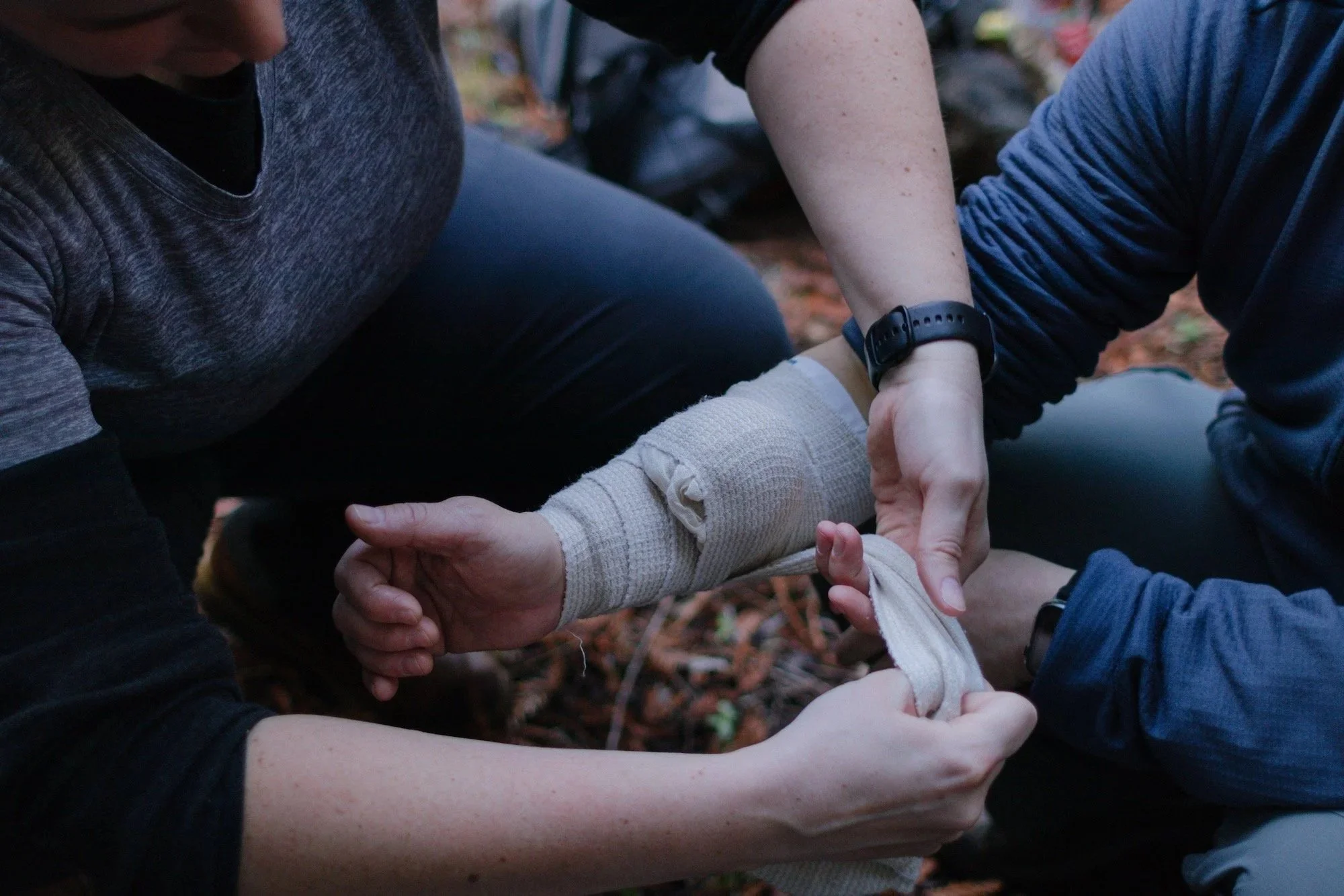
A BMG student scenario in the field.
1. It costs more.
Building a kit piece by piece sounds thrifty until you realize medical supplies come in oddly enormous quantities:
Need a few gauze pads? Minimum order is 50.
Want a packet of wound wash? How about a liter.
Commercial kits often beat your DIY attempt on price alone because they buy in bulk so you don't have to.
2. You'll overthink everything.
Welcome to the paradox of choice. Do you want the triangular bandage that's cotton? Muslin? Pre-tied? The tactical one made of space materials? At some point your "simple pack list" becomes you staring at an online catalog at 1 a.m. debating the significance of ACE wrap elasticity, length, width, etc.
3. You'll still end up missing something.
Usually the thing you end up needing most.
Our Suggestion: Buy, then Modify The System That Works For You
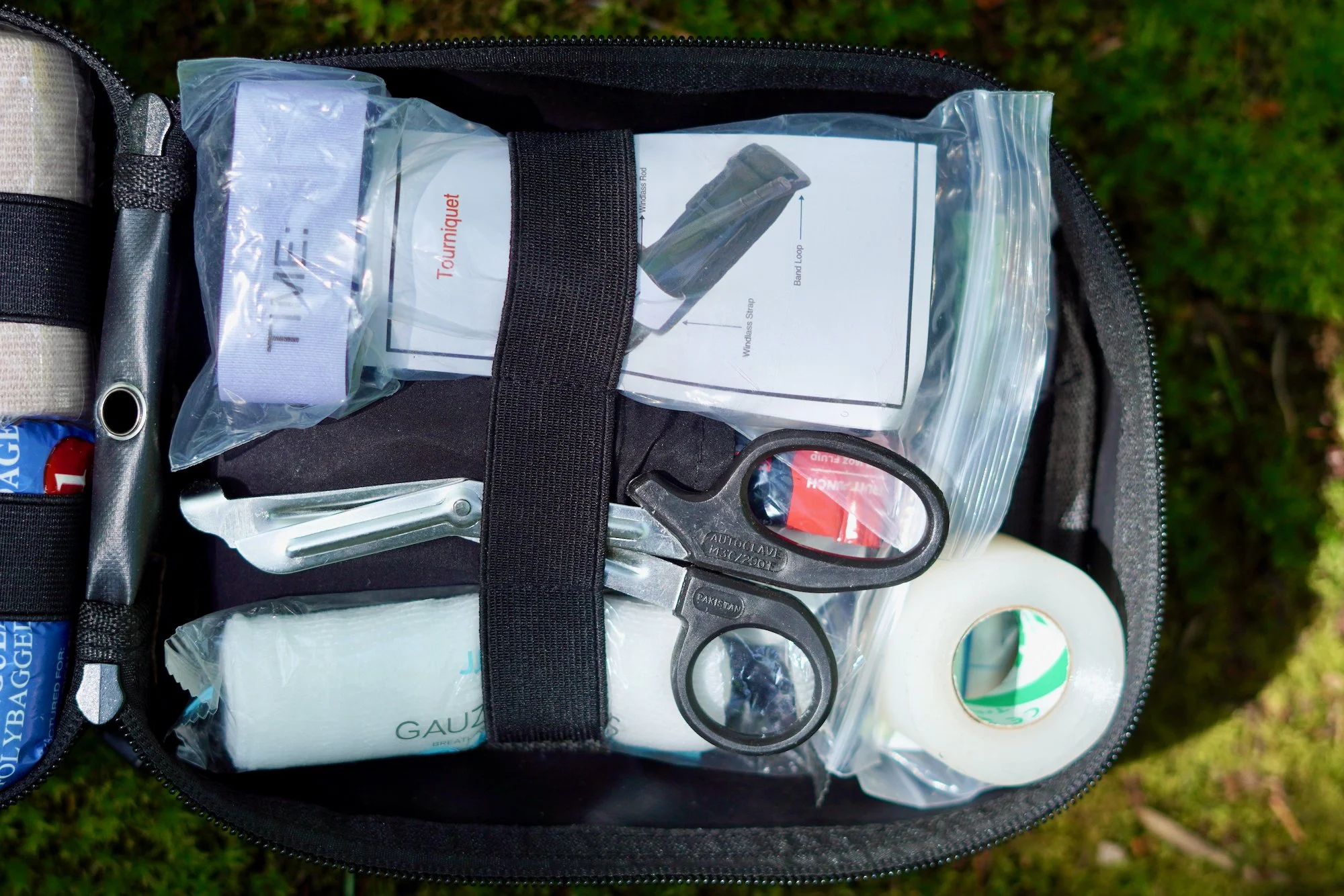
Backcountry Medical Guides First Aid Kit.
After years of field testing the recommendation we give students is simple: Buy a high-quality commercial kit. Then customize it.
That gives you:
A solid baseline
A reasonable cost
A curated selection of essentials
A starting point you can tune to environment, skill level, & trip style
Then, add what matters for you:
A (real) tourniquet in certain settings
Meds you prefer (and that match your party's medical history)
A better blister kit (common)
A SAM splint if you're traveling far or weight isn't an issue
Extra gloves
Pre-built structure plus personal tailoring is, in our experience, the best of both worlds.
We built the BMG Guide Kit to be exactly that. Real CAT tourniquet. Real chest seal. Real Splint. QuikClot. Trauma shears, irrigation syringe, full wound-management section, blister kit, dental kit, OTC meds, and a laminated quick guide so the most useful information isn't sitting at the bottom of your pack. About 30+ items, dialed for backcountry use, and modifiable from there. Whether you buy ours or someone else's, the principle is the same: start with something curated by people who use this stuff, then make it yours.
The "Omit Kit": The Philosophy That Saves Weight and Makes You Smarter
One of the concepts we teach at Backcountry Medical Guides is the Omit Kit.
Here's how it works:
Start with a well-stocked, well-thought-out kit.
Remove things, on purpose, because you have a rationale for not bringing them.
This forces you to think critically:
Where am I going?
What environmental hazards exist?
What can I improvise from the landscape?
How many people are on the trip?
How remote is it?
How skilled am I? (No shame: "rusty but enthusiastic" is a recognized medical profile.)
Example: If you're headed into dense Pacific Northwest forest and want to pack light, you might leave the SAM splint behind because you know good splinting materials are abundant. Instead, you might bring:
A compact roll of tape
Trauma shears
A compression bandage
A triangular bandage or two
Your kit shrinks to something the size of a sandwich, but only because you made a plan. The Omit Kit philosophy protects you from overpacking, ensures that you’re being intentional and builds medical reasoning into your trip planning.
So, Improvise or Not? Here's the Real Answer.
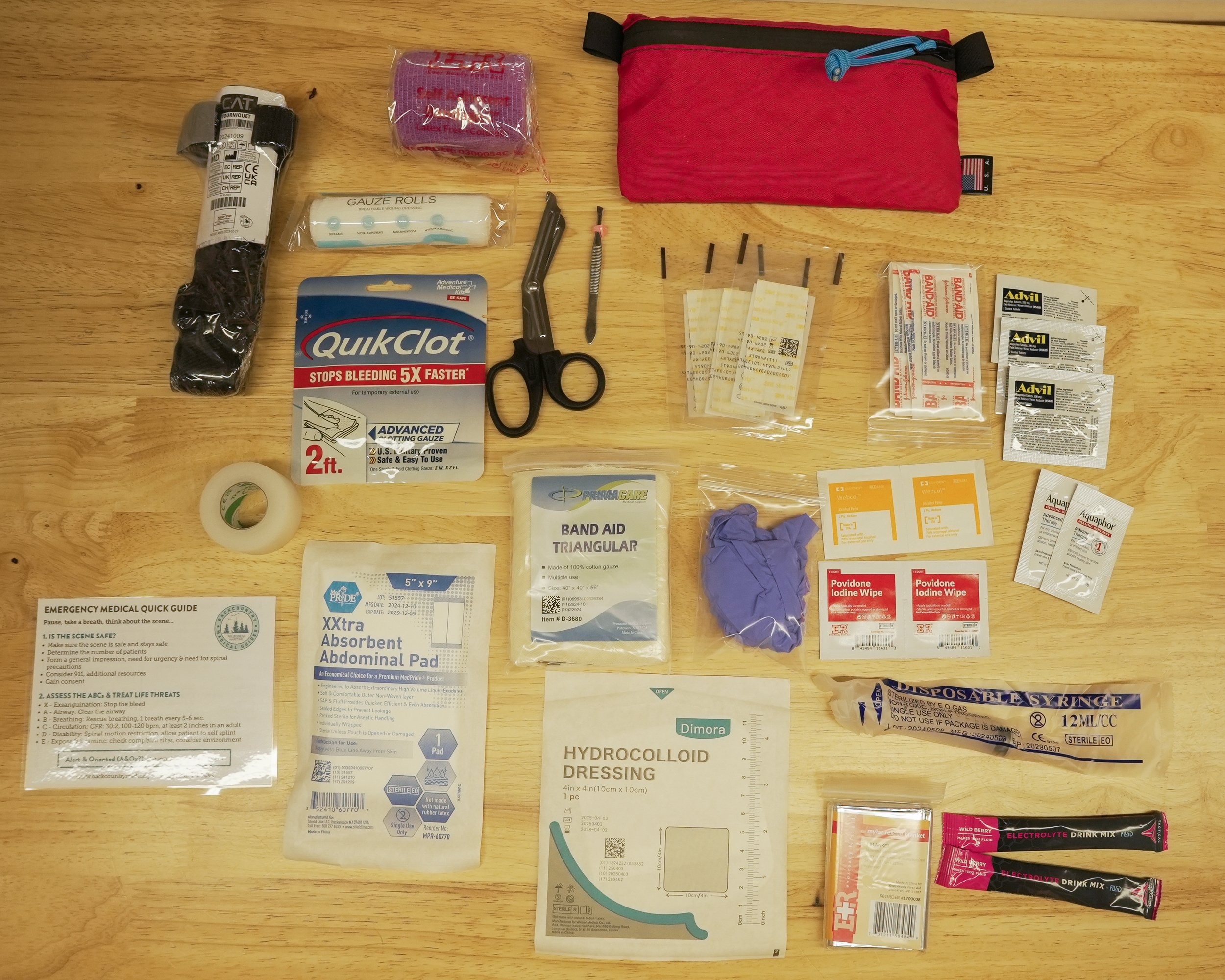
The BMG Summit Kit.
Improvising skills = essential.
Improvised kits = often more expensive, heavier, less effective, and more confusing.
Best practice = buy a good kit, customize it, omit what you don't need.
You’ll end up with:
A kit you know and understand
The right gear for your environment
A manageable pack size
Reliable, approved tools (not rubber-band tourniquets)
Confidence to handle emergencies from the alpine to the trailhead
And here's the truth: your kit should evolve with your experience. Every time you use it, or don't, you'll refine it. Eventually your kit becomes something unique to you. Not because you improvised everything, but because you curated it with intention.
Final Takeaway
Build your skills. Buy your baseline. Modify with purpose. Improvise only when appropriate. And whenever possible, avoid rubber-band tourniquets.
Your future self — and your patients — will thank you.