
Cougars in the PNW: What’s Happening, What Works, and What Doesn’t
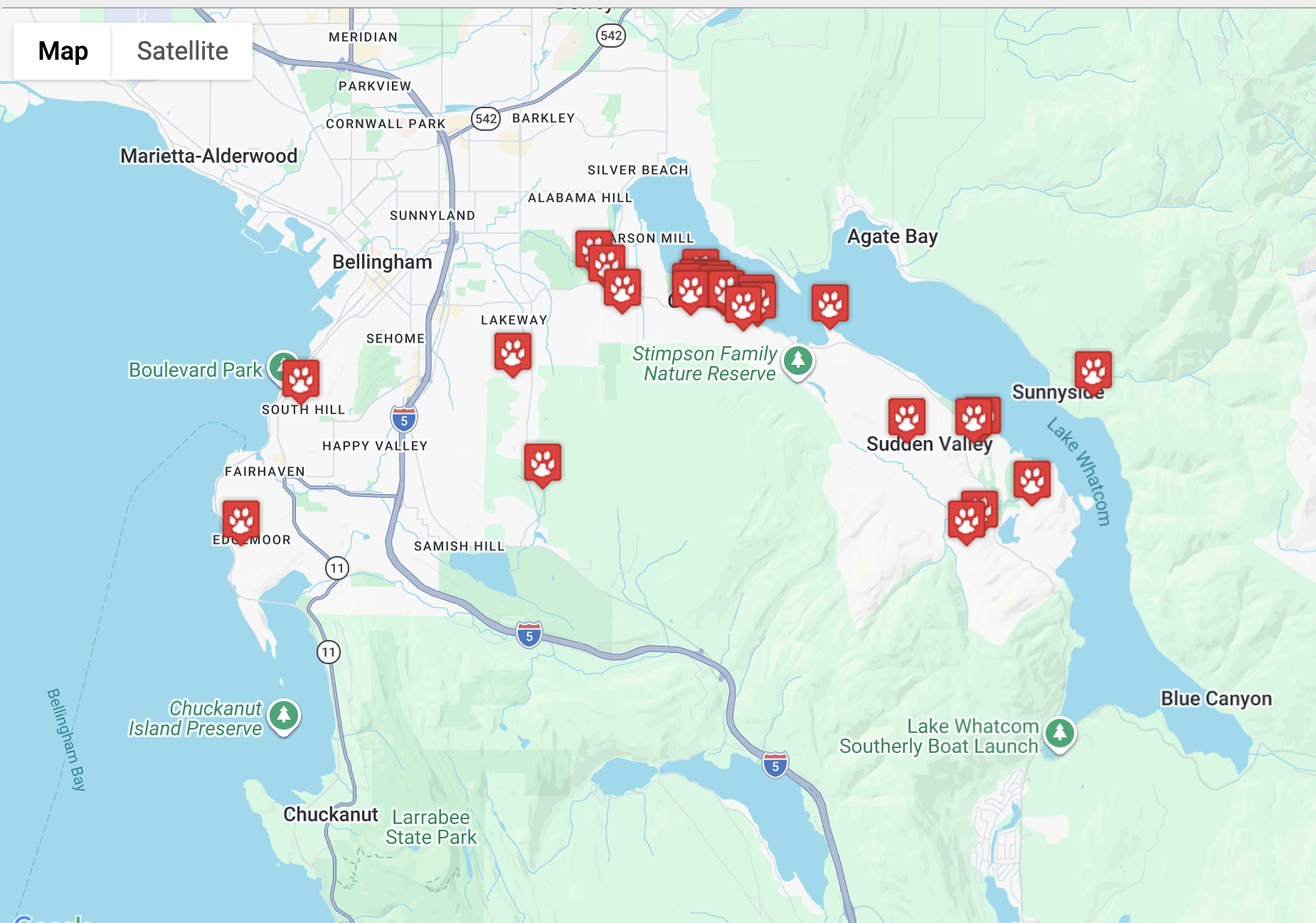
Screenshot of the WDFW's publicly available incident map tracking cougar sightings and encounters statewide.
For three months last winter, a 145-pound male cougar lived in the Geneva neighborhood just outside Bellingham, Washington, just a few blocks from Geneva Elementary School, Whatcom Hills Waldorf, and a preschool. He stashed deer kills in front yards, watched from the brush as kids played, and was spotted relaxing in daylight hours against a fence line on Cable Street. Parents stopped letting children outside alone. WDFW monitored the situation closely, but state policy limited their options. Intervention requires documented predation on a domestic animal, a threshold that left residents in an uncomfortable waiting game.. On February 28, 2026, a doorbell camera caught him trotting down a driveway with a small dog in his mouth. He was trapped within hours and euthanized.
The same month, a solo mountain biker on Galbraith Mountain encountered a cougar on the Overtime trail, lifted his bike, made noise, and backed away slowly; all the right moves. The cougar sat there and watched him. It didn’t flee. This is not unusual behavior for a young, inexperienced animal that has spent months around people and learned not to fear them.
This Isn’t Rare Anymore — It’s a Pattern
Cougar attacks in North America are still rare in absolute terms: roughly 130 documented attacks over the past 100 years and 29 fatalities. Your odds of a fatal encounter are approximately 1,000 times lower than being struck by lightning (Mountain Lion Foundation, 2024). But contact is rising. This isn’t because cougar populations are exploding, but because outdoor recreation has expanded enormously into cougar habitat since the 1970s, when there weren’t nearly as many people camping, hiking, and mountain biking in wild terrain. WDFW has logged 859 incident reports through mid-2024, with concentrations in Whatcom, Snohomish, and Kittitas counties.
Why They Come Toward People
Cougar encounters fall into two patterns. The first is predatory behavior: a hunting instinct triggered by prey-like movement- think fast, small, isolated, or low to the ground. The February 2024 attack on five cyclists near Fall City fits this. Moving fast on a trail in low-visibility terrain checks every box of how a cougar identifies prey.
The second pattern is what wildlife managers call investigative or displaced behavior: a young or food-stressed animal without an established territory, testing what you are because it hasn’t been taught otherwise. The Geneva cougar was almost certainly in this category. Development at wildland-urban edges, changes in deer corridors, and shifts in prey distribution are all pushing more of these animals into contact with people.
Before You Head Out: Steps You Can Take To Reduce Risk
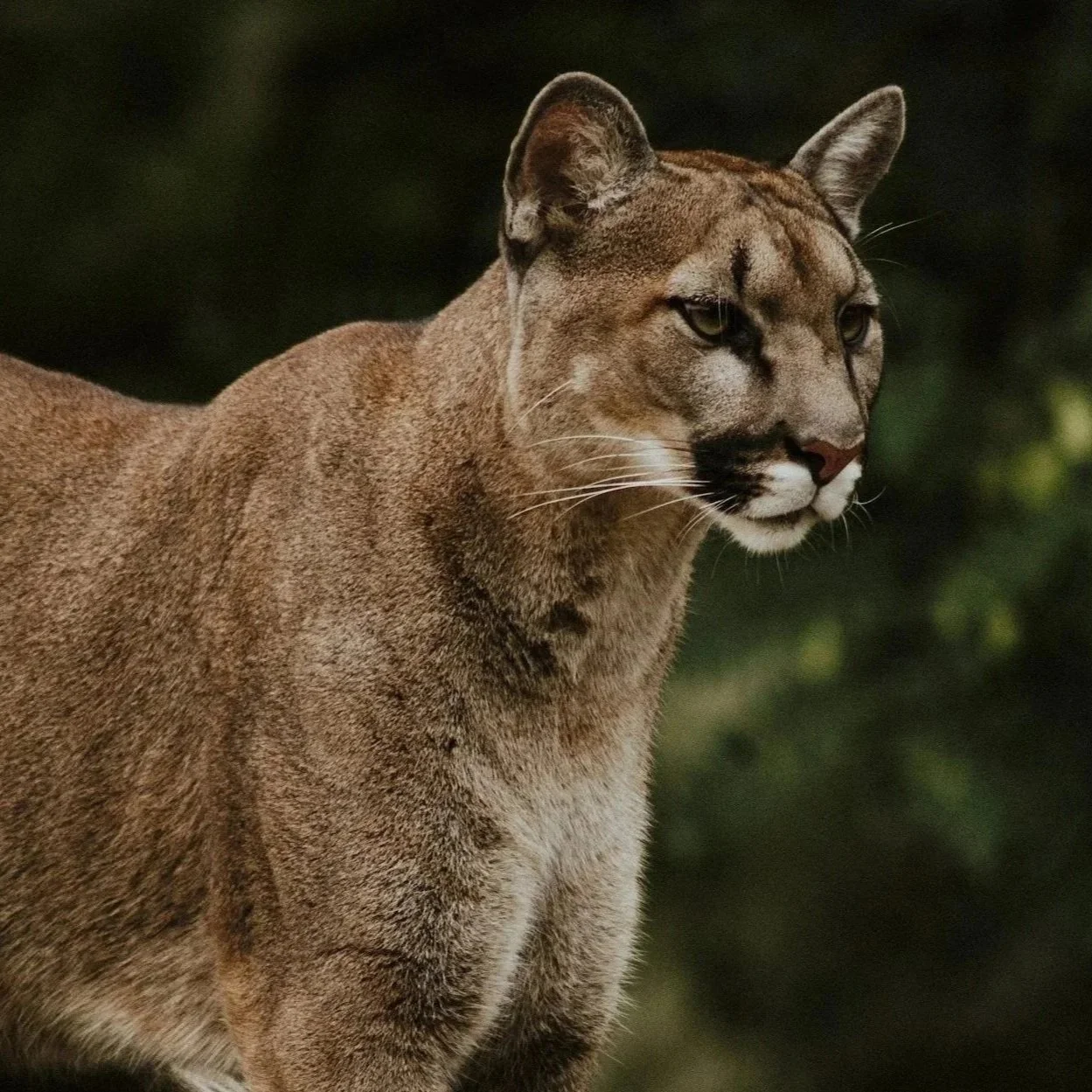
Adult male cougar. Washington state has an estimated 3,000-4,000.
Check for recent cougar activity with local land managers or WDFW before trips in known habitat. The information is publicly available and often updated after incidents.
Don’t go alone in high-density cougar areas, especially at dawn, dusk, or night, which are peak activity hours.Groups of three or more dramatically reduce risk. Cougars are ambush predators (they rely on surprise and a single target); a group disrupts both.
Keep children within arm’s reach. The Olympic NP incident and the global pattern are consistent: small individuals and children are disproportionately targeted.
Make noise. A cougar that hears you coming almost always moves off. Silent trail running in cougar habitat is a documented risk factor.
Carry bear spray and keep it accessible, ideally on a hip belt, not buried in your pack. No peer-reviewed study has tested bear spray specifically on cougars, but the physiological mechanism is well-established (Miller, Zoo Biology, 2001). The foundational bear spray study (Smith & Herrero, Journal of Wildlife Management, 2008) found 92% effectiveness in bear encounters, and WDFW recommends it as a cougar deterrent. It’s not guaranteed, but it’s the best portable deterrent available.
Two Things That Don’t Work the Way You Think
Googly Eyes on the Back of Your Head
This sounds absurd but has a legitimate research lineage. In 1986, forest workers in India’s Sundarbans began wearing human face masks on the backs of their heads to deter tiger attacks and for the next three years, no mask-wearer was attacked. Cougars are also ambush predators that strongly prefer attacking from behind when undetected; so the same logic applies. A four-year livestock study in Botswana found that none of the 2,061 cattle painted with artificial eyespots were killed by lions, while 15 unmarked cattle were (Communications Biology, Nature, 2020). The masks eventually stopped working as tigers learned to distinguish them from real faces. PNW cougars, with far less human exposure, might take longer to adapt, but that’s speculative. No wildlife agency recommends this. It’s scientifically grounded, unproven for cougars, and not a safety strategy. An interesting footnote, not a protocol.
Your Dog as a Bodyguard
A leashed dog may reduce daytime trail attack risk (likely through early detection) since dogs can hear, smell, and sense a cougar before you can (Mountain Lion Foundation, 2024). That’s real and worth knowing. An off-leash dog running ahead is a different story: it can trigger a chase, circle back to you being pursued, startle a cougar you otherwise may have avoided, or simply become prey itself. A small dog off-leash in cougar country is not a bodyguard, it’s an invitation. (WTA cougar safety)
What to Do If You See a Cougar
Cougar encounter response is nearly the opposite of grizzly bear defensive encounter response. Confusing the two is a serious mistake.
Do not run. Running triggers predatory pursuit. Stand your ground.
Make yourself large and loud. Raise your arms, open your jacket, speak firmly and continuously. Assert yourself.
Do not crouch or turn away. Crouching mimics four-legged prey posture and exposes your neck. Maintain eye contact and face the animal.
Back away slowly. Give it a clear escape route. Never corner it.
If it attacks, fight back immediately. This is the defining difference from grizzly protocol. With a cougar, passive behavior reads as submission and continuation of the predatory sequence. Use sticks, rocks, trekking poles, your pack, bare hands. Target the face, eyes, and nose. WDFW confirms that people who fought back have successfully driven cougars away. Never play dead with a cougar. With a grizzly defensive attack, playing dead can end the encounter. With a cougar, it confirms the attack is working. Fight back from first contact.
If Someone Is Attacked: Field Response
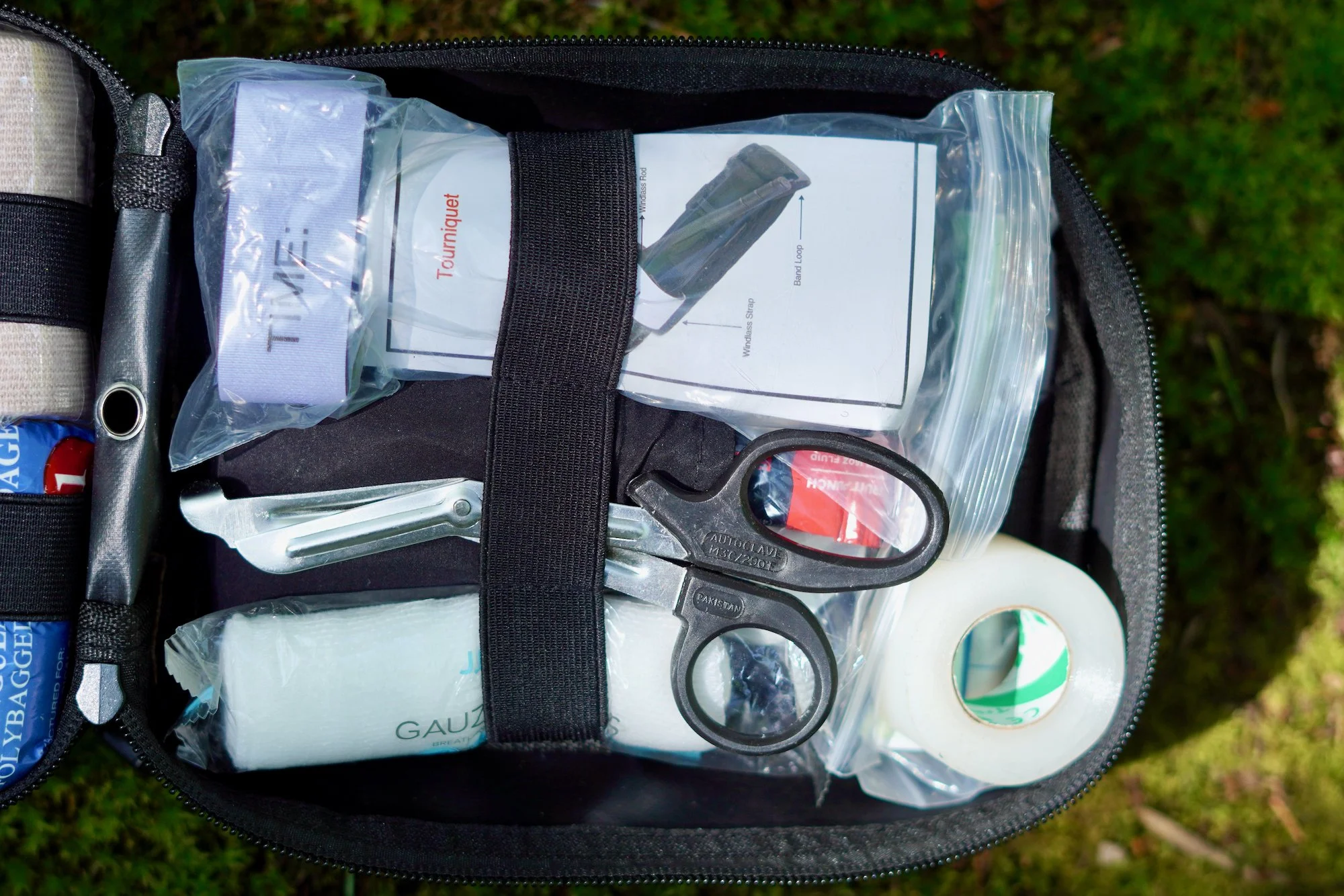
Backcountry Medical Guides First Aid Kit.
Cougar attacks produce puncture wounds (from canine teeth, which are the large pointed teeth generating bite force) and lacerations (from claws), concentrated on the head, neck, and upper extremities. Assess immediately: is there arterial bleeding (bright red, pulsing) from the neck or limbs? Is the airway clear? Hemorrhage control is the first priority. Apply direct pressure to wounds, tourniquet on extremity arterial bleeding. If no tourniquet is available and bleeding is arterial, wound packing (filling the wound cavity with gauze or cloth and holding firm pressure) is the field alternative. Activate evacuation immediately regardless of how wounds appear. Even seemingly minor bites carry significant infection risk from Pasteurella and polymicrobial oral bacteria. These are the same organisms that make domestic cat bites notoriously prone to deep soft tissue infection and require hospital wound irrigation, antibiotics, and rabies protocol evaluation.
What to Report
In Washington, report cougar incidents to WDFW online or at 1-800-CALL-WDFW. In Oregon, contact ODFW. Reporting creates the data record that informs management decisions and alerts other recreationists. The Geneva story got as much attention as it did partly because residents reported consistently over months. You’re part of the monitoring system when you’re out there.
Most people in PNW backcountry will never have a threatening cougar encounter. The ones who do are increasingly likely to be moving fast, alone, or in a place where a young inexperienced animal has been spending time. The Geneva cougar was there for three months before anyone outside the neighborhood knew. Know the behavior, know the protocol.
Leave a comment: Have you had a cougar sighting or encounter in your area this season?
What did you do, and what would you do differently now?
References
Statistics & Biology
Mountain Lion Foundation — Risk and Recreation (2024): Attack data, historical trends, recreation context
Smith, T.S., Herrero, S., DeBruyn, T.D., & Wilder, J.M. (2008). Efficacy of bear deterrent spray in Alaska. Journal of Wildlife Management, 72(3), 640–645.
Miller, D.S. (2001). Review of oleoresin capsicum (pepper) sprays for self-defense against captive wildlife. Zoo Biology, 20(5), 389–398.
Communications Biology (Nature) — Eyespot deterrent study, 2020: Four-year Botswana livestock study
Oregon Hikers — Googly eyes / tiger mask discussion
WTA — Hike Safely in Cougar Country
Geneva / Sudden Valley Story (Dec 2025 – Feb 2026)
Bellingham Herald / Yahoo News (Feb. 14, 2026) — Community impact: Schools notified, residents' accounts, WDFW response
KING 5 (Feb. 2026) — Parents’ perspective: Children kept indoors, deer kills in yards
Spokesman-Review (Mar. 2, 2026) — Euthanization: 145-lb male trapped and euthanized after dog attack
Cascadia Daily News (Mar. 2, 2026) — Cougar euthanized after dog attack
KING 5 wrap-up: Cougar euthanized after dog attack
The Cooldown (Feb. 15, 2026) — Mountain biker encounter on Galbraith / Overtime trail: Solo biker did everything right; cougar didn’t move
KIRO 7 — Three cougars spotted in Bellingham neighborhood: Mother and cubs; deer-feeding cited as draw
Prior Incidents Referenced
NPR: Cougar Attacks Five Mountain Bikers in Washington State, February 2024
OPB: Cougar Safety Tips for Pacific Northwest Hiking, August 2025
Wilderness Medical Society Clinical Practice Guidelines: Animal Attacks
WDFW Cougar Incident Reports 2024: wdfw.wa.gov