
It's smoky outside. Should you still run?
A runner's guide to the AQI, the dose equation, and knowing when to stay in
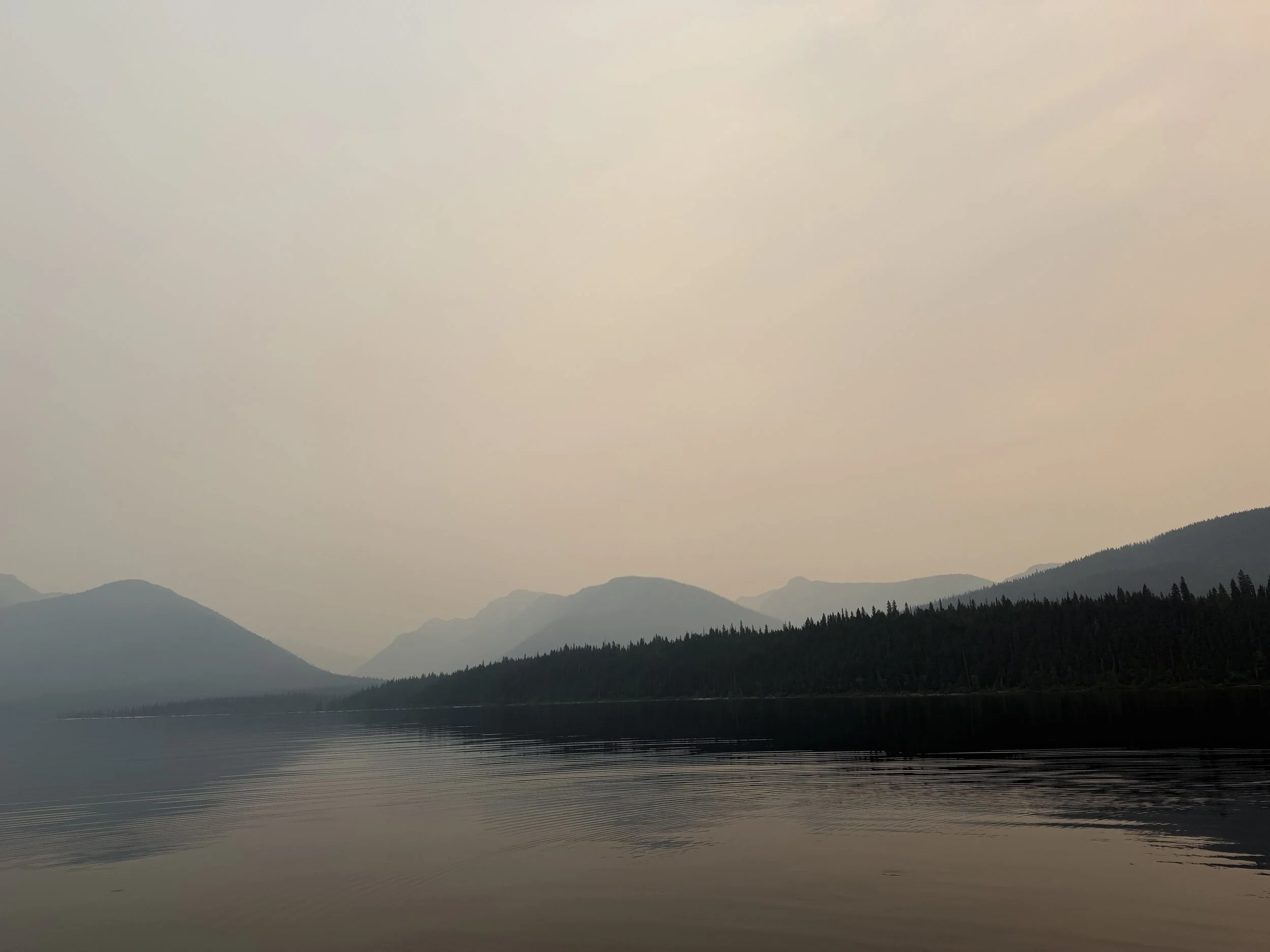
For a growing stretch of the year, prime trail-running season across the West is also wildfire-smoke season. The two overlap when you most want to be out on the trails. Long summer evenings and dry singletrack. Then a smokes settles in and the trails you were going to run seems less appealing. The question stops being “how far” and becomes “should I go at all.” This post is about answering that honestly, using a number you readily have access to.
What you’re breathing in on smoky days
Wildfire smoke is mostly fine particulate matter — PM2.5, particles smaller than about 2.5 microns, roughly thirty times smaller than the width of a human hair. The size is the problem. The particles slip past the filtering hairs and mucus in your nose, go deep into the small airways of the lungs, and in the finest fractions cross into the bloodstream. Short-term exposure is linked to airway inflammation, worsening asthma and COPD, respiratory infections, and added strain on the heart. This occurs whether you have a pre-existing condition or not.
Running makes the impact of smoke worse in specific, measurable ways. At an easy jog you move several times more air per minute than at rest, and you do most of it through your mouth — bypassing the nose's filter entirely. Every notch you raise your effort raises the amount of smoke you pull into your lungs. The runner is not an average member of the public on a smoky day. You're the high-exposure case.
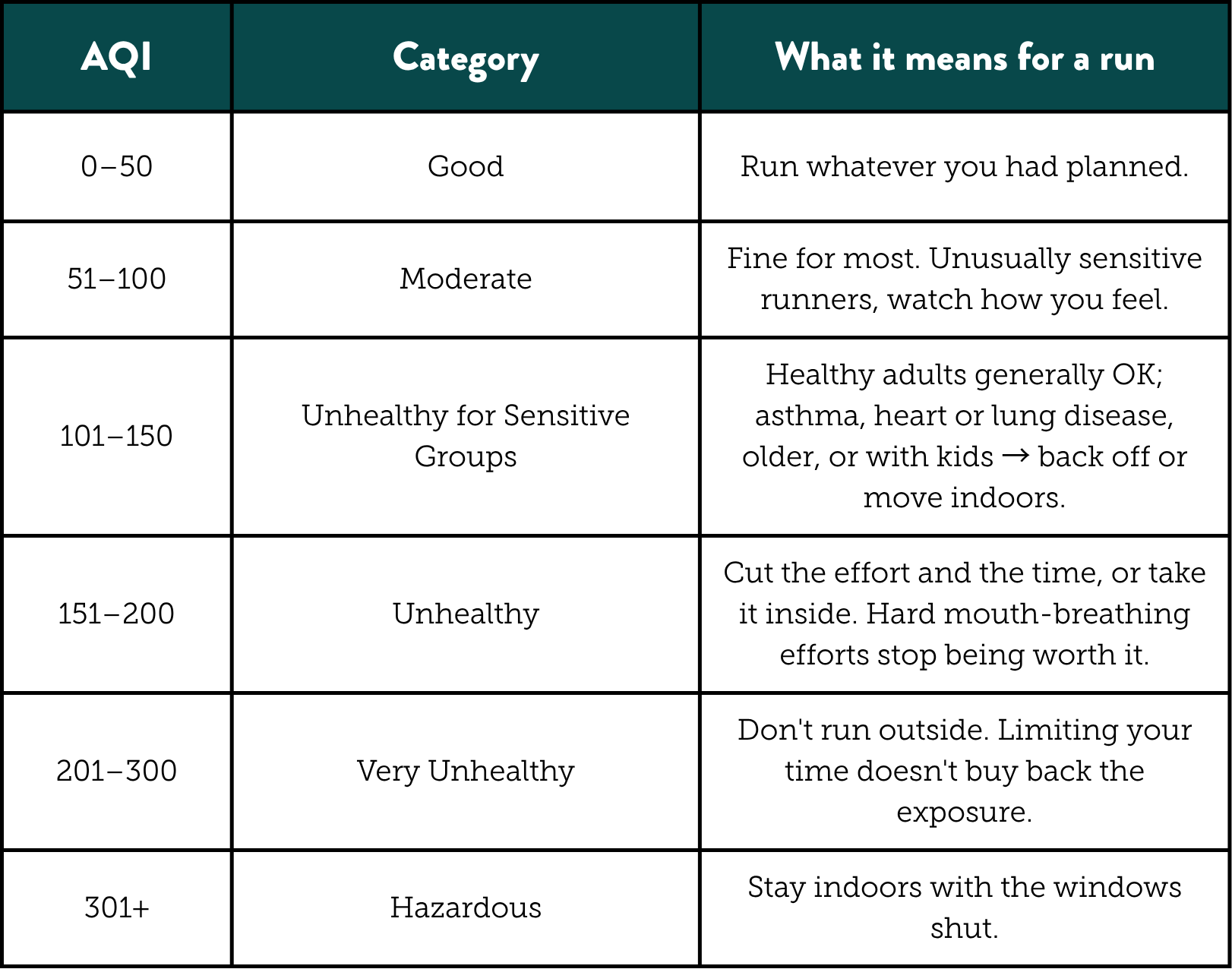
Reading the AQI
The Air Quality Index is the U.S. federal scale that turns pollutant concentrations — on smoky days, driven by PM2.5 — into a single 0-to-500 number with color bands. It is the cleanest tool you have for a go/no-go call.
If you take one idea from this post, take this.
The smoke you inhale is the product of three thing: Dose = concentration × how hard you're breathing × how long you're out.
You can lower any one of them. The air is 155 and you badly want to move? You can't change the concentration, but you can cut the other two: make it a 30-minute easy shakeout instead of a two-hour tempo. This is why “just a short hard interval session” on a smoky day is the worst of both worlds; short doesn't save you if the effort is high.
Practical calls for smoky days
Check the air quality index before you lace up. AirNow.gov, the PurpleAir map, and Wunderground give you current PM2.5.
Time of day. In many mountain valleys smoke pools overnight and can be worst in the early morning, sometimes lifting as the day heats and mixes. Don't assume ideal air quality first thing in the morning, check before you head out.
Trust your body over the numbers. Chest tightness, wheezing, a cough that won't settle, headache, burning eyes, or lightheadedness means it’s time to call it, regardless of what the app says.
Skip the “run mask.” A well-fitted N95 filters PM2.5, but it's built for standing around, not moving air at a runner's rate; it gets wet and seals poorly on a sweaty face. If you're reaching for a mask, you probably already know you shouldn’t be heading out for a run.
Have an indoor plan. A treadmill, bike trainer, pool, or strength day keeps your fitness intact without the exposure. Reframe a smoke day as a cross-training day.
Sensitive groups get a lower ceiling. Asthma, cardiovascular or lung disease, pregnant, older, or running with children — treat each category as one step worse than the table above, and carry your rescue inhaler if you use one.
You cannot out-train a lungful of smoke, and one missed workout costs you nothing you can't get back. A season of running through orange and red air can. Check the real-time number, run the dose equation in your head — concentration, effort, time — and when it doesn't add up, take it inside. The trail will still be there when the air clears.
This article is educational and is not a substitute for personalized medical advice. If you have a respiratory or cardiovascular condition, talk with your clinician about your own thresholds for exercising in poor air quality.
Reference
U.S. EPA. Using the Air Quality Index (AQI) to Plan Daily Activities; “Should You Exercise Outside in Air Pollution?” AirNow.gov.
Public Health Institute. Experts Offer Advice on Working Out During Wildfire Smoke Events.
Colorado State University, College of Health and Human Sciences. Is it safe to exercise outside when there is wildfire smoke in the air?
American Council on Exercise. Strategies to Exercise Safely When Wildfire Smoke Fills the Air.